Cobrastyle by Teddybears on YouTube.
 Some days ago I felt like redecorating my room. There was a large poster on one of the walls which I wanted to replace by another one. I started looking for poster of bands and musicians I like. But either I found nothing at all or the posters were much to small (I wanted it to be A0, which is approx. 120 cm × 84 cm). So I thought, why not designing my own poster and printing it out. A few months ago I found a software called “Rasterbator” which divides a large poster into single pages which you can then print out with your own ink or laser printer. There are a lot of impressive pictures from posters people did that way on the Internet. Just look for “Rasterbator” at your preferred search engine.
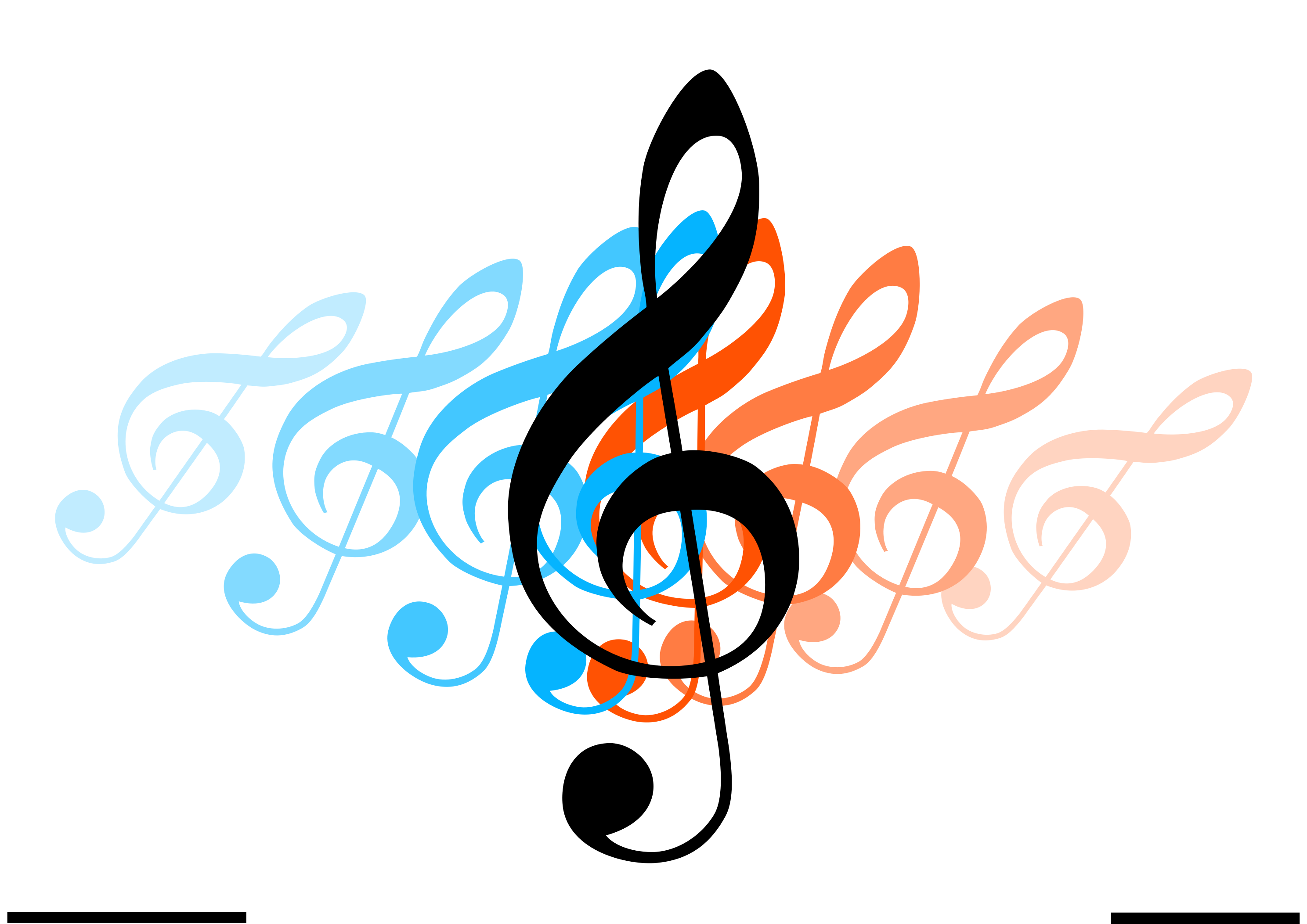
Anyway, I thought I could design a poster myself, print it out and put it on the wall. If I made it as a vector graphic I could scale it to any size and print it as large as I wanted. So all I needed was some design which represented music, because that’s what I wanted to be on the wall. I started to play with a note, but didn’t come far. So I looked for a vector graphic of a treble clef which I could use. I found one, did some arrangements, two versions (one white, one black), and you can see what the result looks like.

Now that the poster is ready, I release it into the public. If you like it just print it out yourself. If you want to use it as a basis for your own poster design, feel free to do so. Creative Commons makes it easy.
Downloads
Here are some files you might want to download. I made both posters in A0 (1188 mm × 840 mm) and A1 (840 mm × 594 mm). You can choose between the normal and the rasterized version.
- PDF 1 A0 page: black clef on white, white clef on black
- PDF 16 A4 pages: black clef on white, white clef on black
- PDF 1 A1 page: black clef on white, white clef on black
- PDF 8 A4 pages: black clef on white, white clef on black
And here are the source files:
- SVG A0 black clef on white, white clef on black
- SVG A1 black clef on white, white clef on black
License information
The poster “Treble clef” is licensed under a Creative Commons Attribution Share Alike 3.0 License. This regards the PDF-files and the Scalable Vector Graphics source SVG-files. It uses parts of the image “Bass and Treble clef.svg” by “Lthown” which was published under a Creative Commons Attribution 3.0 License.

In January 2009 Nine Inch Nails released 405 GB of HD footage from their 2008 “Lights In The Sky” tour. During a period of twelve months dozens of fans collaborated to produce a professional-quality HD 5.1 concert film. They call themselves “This One Is On Us” and the concert film they named “Another Version Of The Truth: The Gift” is available as a free download from the website in various formats (Blu-ray, DL-DVD, 1080p MOV, for PSP+iPod, etc.).
I shouldn’t forget to mention that there is an audio only version as 320 kbit/s MP3 and FLAC. Download links can be found on this page under “Mastered Audio MP3/FLAC”. It makes a great 32 track life album.
And if you like just browse the website. There is lots of stuff on it besides the film, like rehearsal footage and a concert filmed entirely by fans.
You can watch the whole film on YouTube here or only an excerpt below.
Discipline by Nine Inch Nails on YouTube from fan collaborated concert film production “Another Version Of The Truth: The Gift“.
Gekommen Um Zu Bleiben by German band Wir Sind Helden on YouTube.
Ghostwriter by RJD2 on YouTube.
Tonight I’m going to attend a concert of RJD2 in Uppsala, Sweden. I don’t know much of his work but what I know is really cool stuff and I love sampling. I’m so excited!
It’s obvious that Rihanna covered “Tainted Love” by Soft Cell with “SOS”. But did you know that Crazy Town’s Butterfly” samples “Pretty Little Ditty” by Red Hot Chili Peppers? Or that Lady Gaga’s “Pokerface” used music from Boney M.?
There’s a whole database about sample-based music called WhoSampled. Try browsing it. It’s astonishing.
“RiP!: A Remix Manifesto” is a 2008 documentary film about copyright in music in past, present and future. It tells many interesting stories surrounding the evolution of music as we know it today and the part copyright plays in that process.
The director Brett Gaylor bases his film on four assumptions:
- culture always builds on the past
- the past always tries to control the future
- our future is becoming less free
- to build free societies you must limit the control of the past
It starts telling the story of Girl Talk an American musician who creates his music solely by sampling other music. This is against the current copyright laws because he uses copyrighted material of other musicians without permission. So Girl Talk is someone who builds on the past. But Gaylor shows that music was always built on the past. He tracks the traditional folk song “This May Be The Last Time“, recorded by The Staple Singers in 1959, to The Rolling Stones “The Last Time” from 1965, to an instrumental version by Andrew Oldham Orchestra in 1966, to “Bitter Sweet Symphony” by The Verve in 1997. The Verve was sued by The Rolling Stones’ publishers and Keith Richards and Mick Jagger took all writing credits.
Lawrence Lessig, a founding board member of the Creative Commons, says that you can’t stop people from using technology to remix culture. You can only criminalize them. He argues that similar to quoting text in an essay one should be allowed to also “quote” film and music to create a new work.
Cory Doctorow, a blogger, journalist and author, who releases his novels under Creative Commons licenses, talks about how business models are changing over time. In the times before radio and record people could only make money from making music by playing it live. The musician had to be charismatic for that to work. With records and radio the need for live performances to earn money from music was gone. From his point of view today large corporations try to save their business models, which are based on selling records. But maybe we reached a point in history where selling records has lost it’s potential to make money. Maybe today the musician has again to perform live to make a living. Why should these companies be allowed to stop these changes from happening? Should the musicians some decades ago have stopped companies from selling records and destroying their business model of live performances?
The film can be watched online in full length (1:26:25) on the website of the National Film Board of Canada in HD. You can also download the film and pay what you want (even nothing at all) on the film’s website.
Here’s the trailer:
OK Go – This Too Shall Pass [Rube Goldberg Machine version] by OK Go on YouTube.
The most awesome music video ever!
There’s also a making of and an article on Wikipedia: Second music video: Rube Goldberg Machine
Making of TTSP #1 – OK Go, Making of TTSP #2 – OK Go, Making of TTSP #3 – OK Go, and Making of TTSP #4 – OK Go, by OK Go on YouTube.